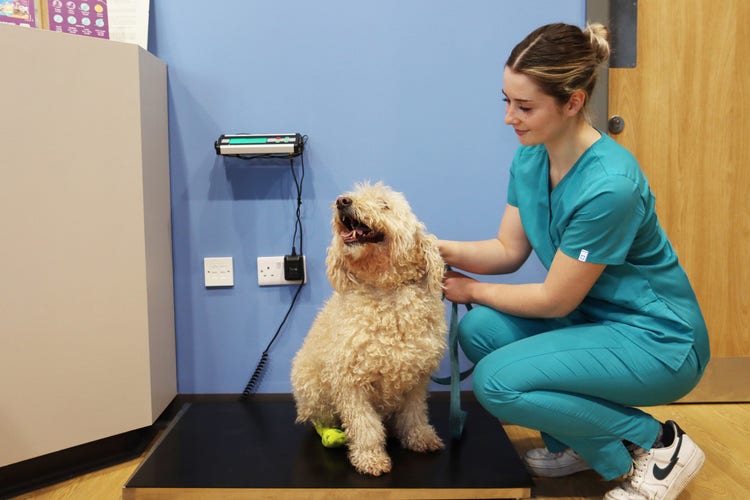
Heart Disease in Cats & Dogs
Your vet may have identified signs of heart disease in your cat or dog and advised investigation. This is most commonly a heart murmur or irregular rhythm heard on auscultation.
When we listen to the heart with a stethoscope, we hear two noises for each heartbeat as the heart valves close. A heart murmur describes noise present in addition to the normal heart sounds, caused by turbulent blood flow. The character and location of a murmur can give us a clue about what exactly is causing it, however only a heart scan can provide a definite diagnosis.
Murmurs are graded from 1 to 6, with a grade 1 murmur being barely audible, and a grade 6 murmur being much louder than the heart sounds. The volume or grade of a murmur does not necessarily correlate with the changes present, and we cannot assume that a quiet murmur is not a problem.
Common causes of murmurs:
- A valve leaking
- A narrow vessel
- A change to the shape or thickness of the heart chambers
Echocardiography
Often called an echo, this is an ultrasound scan of the heart. It allows direct visualisation of the chambers and valves that make up the heart, along with measurement of the contractility, blood flow and valve function.
An echo is performed with the animal awake or under light sedation. It requires some hair to be clipped from the chest but is not painful. Your pet will be asked to lie on a cushioned table in a dark room; it is not uncommon for pets to fall asleep during the scan!
Electrocardiography (ECG)
General blood tests